Your First Visit to a Gallery: A Plan for One Room
A first gallery visit can feel manageable when you choose one room, select one artwork, and use a simple sequence to notice materials, arrangement, and meaning.
A first gallery visit can feel easier when you give yourself one room and one artwork to attend to. For a first gallery visit, the aim is not to understand everything on the walls; it is to notice how one work holds your attention, what it is made from, and what questions arise before you read its explanation.
That approach leaves room for your own response without asking you to pretend expertise. You can move through a room in several useful ways: follow an artwork that draws you in, choose a work whose materials are unfamiliar, or begin with something that makes you hesitate. Each route suits a different mood, and you can change course if your attention shifts.
How should you choose one artwork?
Start by standing where you can see the room without blocking anyone. Let your eyes move across the walls, plinths, and open spaces. Notice which work makes you pause—not necessarily because you like it, but because something about its color, scale, shape, or subject asks for another look.
Once you have a candidate, check whether you can view it comfortably. Is there space to step back? Can you see its surface without leaning into another visitor’s path? If the work is in a crowded spot, choose a nearby alternative rather than forcing yourself to stay. A useful choice is one you can look at without rushing or obstructing others.
You do not need to pick the room’s largest or most prominent work. A small drawing can offer plenty to notice, while a familiar-looking painting may invite questions about its materials or arrangement. The point is to select something specific enough to revisit with your eyes.
Which approach fits your visit?
Three simple approaches can help you make the choice. They are not rules for judging art; they are different ways to direct your attention.
- Follow your immediate pull. Choose the work you keep glancing toward. This suits a short visit or a day when you want to trust curiosity rather than set yourself a task.
- Follow a material. Look for a material or process you do not recognize, such as woven fiber, layered paper, cast metal, or a combination of paint and found objects. This suits visitors who enjoy observing how things are made.
- Follow a question. Choose a work that puzzles, unsettles, or even slightly repels you. This suits visitors willing to sit with uncertainty instead of searching immediately for a pleasing response.
To choose, ask what you want from this room today: a point of interest, close attention to making, or a question that stays open. Pick the route that answers that need. You can always switch if the work stops holding your attention.
What can materials and arrangement tell you?
Begin with what you can observe, not what you think the artist intended. Look for edges, seams, brush marks, repeated shapes, worn areas, reflections, or changes in texture. For a sculpture, notice what supports it and how it meets the floor. For a print or photograph, look at the surface and the way light falls across it. These details give you a grounded starting point.
Then notice arrangement. Where does your eye land first? Does it travel across the work, circle back, or stop at a particular edge? Are shapes balanced, crowded, repeated, or sharply separated? If the piece includes words or recognizable objects, ask how their placement changes your reading. A single object near the center may feel different from the same object pushed to one side.
Try describing one detail in plain language: “The dark marks gather near the lower edge,” or “The cloth is folded over a bright surface.” A description is not a verdict. It gives you something visible to compare with your later interpretation.
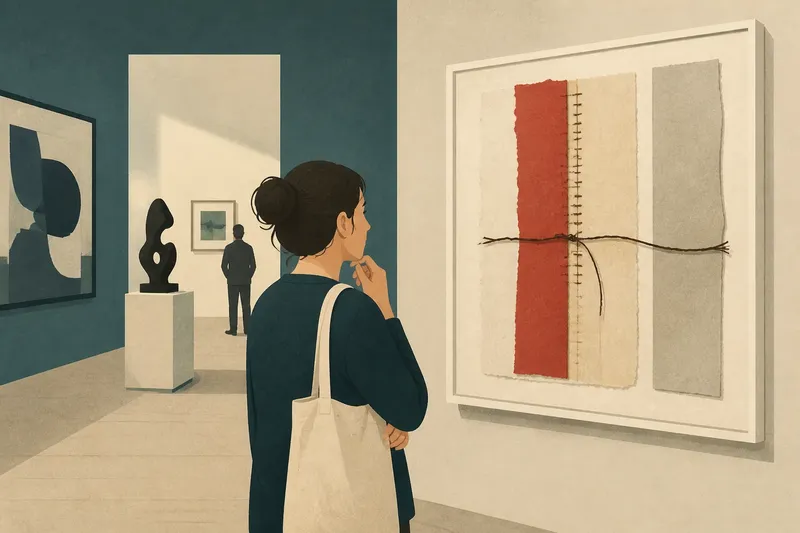
Say you choose an invented mixed-media work with a narrow strip of red paper, rough thread, and a pale panel. You first notice that the thread crosses the paper but stops before reaching the panel’s edge. Looking again, you wonder whether the gap matters or simply gives the materials room. That question can guide your attention without requiring you to solve the work.
How do you look before reading the label?
Give yourself a quiet interval before turning to the wall text. Stand at a comfortable distance, then move closer only if the room and display allow it. Look once for the whole composition, once for a material detail, and once for the route your eyes take. You can spend a few minutes or much longer; the value lies in returning to the same work with a more precise question.
Use questions that invite observation rather than demand a hidden answer:
- What did I notice first, and what did I overlook?
- Which material seems to shape the work most strongly?
- What changes when I look from farther away?
- Does the arrangement suggest movement, stillness, connection, or separation?
- What part remains unclear to me?
You can keep one question in mind instead of collecting a list. If you are visiting with someone, take turns describing details before discussing what you think they mean. Different observations can coexist; neither person needs to produce the correct interpretation.
What should you read on the wall label?
After looking, read the label as context, not as a key that cancels your response. The artist’s name, title, date, medium, and accompanying text can help you identify what you are seeing and place it within a larger conversation. If a term is unfamiliar, use the label’s wording as a prompt for another look.
Compare what the text says with what you noticed. If it names a material you did not recognize, can you now see how that material behaves? If it offers a subject or setting, does that information sharpen your question, or leave it unchanged? Your first observations remain useful even when the label adds context.
Some works may draw on cultural knowledge, personal histories, or community experiences you do not share. In that case, avoid treating your first reading as the work’s sole meaning. Notice what the label makes clear, what it leaves open, and whose perspective appears in the information provided.
What questions help you look more closely?
Should I read the label before looking?
Either order is reasonable, but looking first gives you a chance to form your own observations. If context helps you engage, read the label and then return your eyes to the work.
What if I do not like the artwork?
Dislike can still point to something specific: a texture, subject, color, or sense of scale. Name that response and see whether it changes as you notice more, without requiring yourself to enjoy the work.
How long should I spend on one piece?
Stay while you are noticing new details or questions, and move on when your attention has settled. There is no required duration for a useful visit.
Can I take notes or make a sketch?
Brief notes or a small sketch can help you remember an arrangement or question, but gallery rules differ. Check posted guidance before photographing, drawing, or handling any materials.
How do you decide when to move on?
Move on when you can describe what caught your attention, name a material or arrangement detail, and hold at least one question—even if you have no answer. That is a complete encounter, not a test you must pass. You might then leave the room, look at another work, or revisit the first piece after reading its label.
For a first gallery visit, choosing one work and returning to it is often more useful than racing through every display. Keep the question that still feels alive as you leave the room. It gives your next visit a starting point, while this one remains yours: a particular artwork, seen with attention.